





IT security policy Template
 10 Downloads
 Technology, SaaS & Media Agreements
  March 4, 2025
 FreshDox
IT security policy template is the starting point for any organization that wants to protect its data, systems, and people in a structured, audit-ready way. An IT security policy is a formal document that defines the principles, requirements, and methods adopted by organizations to safeguard their information systems. It becomes the foundation on which cybersecurity protocols are established in critical areas such as data safeguards, system availability, access control, and risk prevention.
Without a formal IT security policy template in place, a firm is at serious risk of cyberattacks, data breaches, operational disruption, and non-compliance with standards such as NIST, ISO 27001, and SOC frameworks. A written security policy also provides stakeholders, vendors, and employees with clear instructions on how to handle confidential data, prevent unauthorized access, and respond to a security incident or breach.
When implemented correctly, an IT security policy not only enhances the firm’s cyber-resilience but also ensures that safeguards are consistently implemented across all IT-related processes, departments, and locations.
Why Do Companies Need an IT Security Policy?
Protecting Business Assets
An IT security policy template helps protect both digital and physical business assets. Information systems typically hold sensitive information about financial transactions, intellectual property, internal strategy, and confidential customer data—prime targets for hackers, insider threats, and cybercriminals.
Without clearly defined security protocols, businesses expose themselves to malware, ransomware, phishing, business email compromise, and data exfiltration. A structured security policy defines how assets are classified, who can access them, and the safeguards required to keep them protected.
Regulatory Compliance
Security requirements and best practices are outlined in ISO 27001, NIST frameworks, SOC reports, and sector-specific regulations such as HIPAA, PCI-DSS, or GDPR. An IT security policy template ensures that these requirements are translated into practical controls and day-to-day procedures.
Documented security policies demonstrate due diligence, support internal and external audits, and help organizations avoid penalties, fines, and reputational damage arising from non-compliance or data breaches.
Protection from Cyber Attacks and Threats
Cyber threats evolve continuously, from targeted ransomware attacks to sophisticated social engineering campaigns. A comprehensive IT security policy template enables organizations to define how they will identify, assess, and mitigate cybersecurity risks through proactive monitoring, patching, and training.
By outlining clear rules for system hardening, vulnerability management, and incident reporting, a written cybersecurity policy ensures that businesses can detect and counteract attacks before they escalate.
Standardizing Enterprise Security
A formal IT security policy brings consistency to how security is implemented across every department and location. Instead of ad-hoc decisions, all personnel work under a common set of cybersecurity rules, controls, and workflows.
With an established baseline of security controls, businesses can manage network security, identity and access management, endpoint protection, and data handling standards in a unified way, reducing the risk of gaps and human error.
Improved Incident Response and Recovery
A properly documented incident response section within your IT security policy template provides step-by-step instructions on how to detect, report, escalate, and respond to security breaches.
Organizations without a formal response plan often struggle to react under pressure, leading to prolonged downtime, data loss, and higher recovery costs. A well-designed security policy defines roles and responsibilities during an incident, enabling faster containment, focused communication, and a smoother recovery process.
What Are the Provisions in an IT Security Policy?
An IT security policy template is composed of multiple provisions that specify detailed measures, methods, and responsibilities. These sections make it easier to translate a high-level security strategy into actionable controls.
Without a formalized policy, businesses are at greater risk of data breaches, system vulnerabilities, inconsistent practices, and non-compliance with industry regulations.
Access Controls and Authentication
Access control provisions define how employees, contractors, and third parties authenticate and access company information systems. This often includes multi-factor authentication (MFA), role-based access control (RBAC), least-privilege principles, and strong password policies to limit unauthorized access to sensitive data.
A strong IT security policy template requires periodic review of access rights, automatic removal of access for employees leaving the organization, and continuous monitoring for suspicious login activity.
Implementing identity and access management (IAM) solutions can further centralize and automate access governance, ensuring that users only see the systems and data they truly need.
Acceptable Use Policy
The acceptable use section of an IT security policy template sets out how employees may use company-owned devices, software, and networks. It outlines prohibited actions such as installing unauthorized software, using corporate systems for illegal activity, sharing credentials, or posting confidential business information on social media.
Employees are expected to comply with these rules to avoid weakening cybersecurity controls. Organizations may also deploy monitoring software and regular reminders to reinforce acceptable use requirements and detect policy violations early.
Security Awareness Training
Even the strongest technical controls can be undermined by human error. That is why a modern IT security policy template always includes provisions for regular security awareness training.
Training programs teach employees how to recognize phishing attempts, social engineering tactics, malicious links, and suspicious attachments. They also reinforce safe browsing practices, secure data handling, and correct reporting procedures.
To remain effective, training modules should be updated frequently and may include gamified exercises, quizzes, and live phishing simulations to keep staff engaged and vigilant.
Data Classification and Protection
Data classification provisions define how information is categorized (e.g., public, internal, confidential, highly confidential) and what protection levels apply to each category. An IT security policy template typically prescribes encryption, access restrictions, and storage rules for high-sensitivity data.
Organizations may also use data loss prevention (DLP) tools to monitor and block unauthorized attempts to export, email, or upload confidential data outside the company. Regular audits help verify that classification and protection controls are working as intended.
Network Security and Firewalls
Network security provisions address how the organization protects its internal networks, perimeter, and remote connections. This includes firewalls, intrusion detection and prevention systems (IDS/IPS), secure VPNs, network segmentation, and regular patching of routers and switches.
By defining minimum standards for network configuration and monitoring, an IT security policy template helps prevent unauthorized access and lateral movement within the environment.
Malware Prevention and Anti-Virus Protection
Malware prevention measures rely on endpoint protection platforms, anti-virus software, and real-time monitoring solutions to safeguard devices from malicious code, ransomware, and other threats.
The policy should require up-to-date signatures, regular system scans, automatic updates, and the use of advanced threat detection to identify zero-day attacks and suspicious behavior before systems are compromised.
Incident Response Plan
The incident response section of an IT security policy template outlines how security incidents are detected, reported, triaged, and resolved. This includes clear escalation paths, communication channels, and predefined actions for containment and recovery.
A comprehensive incident response plan may cover forensic investigation steps, evidence handling, internal and external notification protocols, and post-incident review procedures.
Organizations should test these procedures through tabletop exercises and simulations, refining the playbooks based on lessons learned. Many companies also designate a dedicated incident response team responsible for coordinating technical and business actions during a cyber event.
Mobile Device Security and Cloud Security
With remote work and SaaS platforms now standard, an IT security policy template must address mobile and cloud environments. Mobile Device Management (MDM) solutions, secure communication channels, and endpoint security for laptops, smartphones, and tablets are all crucial.
For Bring Your Own Device (BYOD) scenarios, the policy should set minimum requirements—such as device encryption, mandatory PINs/biometrics, remote wipe capability, and installation of approved security software—before granting access to corporate apps and data.
Cloud security provisions define how data is stored, accessed, and backed up in cloud platforms, including encryption, identity controls, and shared responsibility with cloud providers.
Password Policy and Authentication Requirements
An effective password policy sets requirements for password length, complexity, reuse, and rotation. It should encourage unique, strong passwords and the use of password managers rather than unsafe practices like reusing credentials or writing them down.
The IT security policy template may also define where and when multi-factor authentication is mandatory and outline the use of advanced authentication mechanisms such as biometrics or risk-based adaptive authentication.
Disaster Recovery and Business Continuity Strategies
Disaster recovery planning ensures that the organization can continue operating after a cyberattack, hardware failure, natural disaster, or other major disruption. Backup strategies, redundancy measures, recovery time objectives (RTOs), and recovery point objectives (RPOs) should all be defined within the IT security policy template or referenced to a dedicated DR/BCP document.
Regular testing of disaster recovery plans through simulations and failover exercises improves readiness. Offsite and cloud-based backups add an extra layer of resilience, allowing critical systems and data to be restored quickly when needed.
Industry Compliance
Finally, the IT security policy template should reference relevant industry and regulatory standards and specify how the organization will maintain continuous compliance. This includes regular internal audits, external assessments by third-party cybersecurity experts, and documented remediation plans.
By aligning with international standards and best practices, companies can build a security posture that not only protects operations but also wins the trust of customers, partners, and regulators.
How Companies Can Benefit from Implementing an IT Security Policy Template
Using an IT security policy template greatly simplifies the drafting process and helps organizations avoid gaps or inconsistencies in their documentation. Instead of starting from scratch, teams can build on a proven framework and tailor it to their own risk profile and industry needs.
A well-structured IT security policy template ensures that all essential topics—access control, incident response, data protection, network security, and more—are covered in a consistent format. This reduces the risk of omissions and makes it easier to demonstrate compliance to auditors and stakeholders.
Free or professionally designed templates also accelerate policy rollout, allowing organizations to focus on implementation, training, and enforcement rather than spending months on baseline drafting. Over time, this leads to better cybersecurity preparedness, stronger governance, and clearer responsibilities across the organization.
Download an IT Security Policy Template with a Free Trial of FreshDox
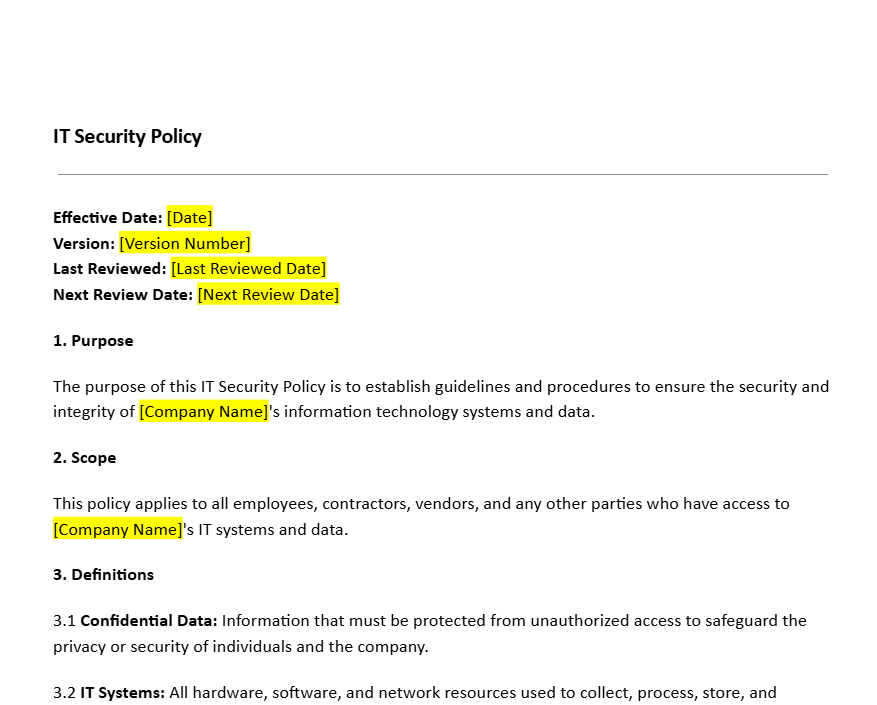
If you are ready to formalize your cybersecurity framework, an IT security policy template from FreshDox gives you a strong, professional starting point. When you sign up for a free trial of a Basic or Premium account, you get immediate access to a fully customizable IT security policy template designed by IT and security specialists.
You’ll have 7 days to browse the entire FreshDox catalog, download the IT security policy template and other related documents—such as incident response plans, acceptable use policies, and data protection policies—in both Word and PDF formats, and tailor them to your company’s requirements.
Whether you are a startup building your first security framework or an established enterprise tightening compliance, FreshDox makes it easy to create clear, comprehensive, and audit-ready policies. Start your free trial today, download an IT security policy template, and give your organization the structured cybersecurity foundation it needs to stay protected and compliant.

 Download Word Template
 Download PDF Template
Related Templates
Discover more templates that align with your needs and preferences.













Ready to Sign Up?
Start your 7-day free trial and access professionally drafted legal documents built for business use.
- Cancel any time
- 7-day free trial
- From 300+ Customer Reviews
