






Patient Referral Form Template: Essential Guide for Safer Care
 8 Downloads
 Healthcare & Social Services Agreements
  March 8, 2025
 FreshDox
Patient referral form template is an essential tool for smooth, safe and well-coordinated patient care. When a patient moves from one healthcare provider to another, a structured patient referral form template becomes the bridge that carries critical information—medical history, current diagnosis, ongoing treatments and reasons for specialist referral—so that continuity of care is never compromised.
Without a standard format, continuity of care can be disrupted by gaps in information, leading to delays, repeated investigations and, at times, avoidable clinical risks. Compliance with privacy and data-protection regulations such as HIPAA also depends on how securely referral information is collected, stored and shared within a consistent patient referral form template.
Mental health professionals, physical therapists, surgeons, physicians and many other healthcare providers often require a formal referral before seeing a new patient. Without clear documentation, receiving clinicians may not have the context they need to accurately assess the patient’s status, resulting in incomplete evaluations, fragmented care plans and frustrated patients.
A well-designed patient referral form template eliminates inconsistencies by capturing relevant symptoms, prior investigations, previous treatments and current concerns in a single, standardised document. This reduces the need for repeated follow-ups and clarification calls. Moving from paper referrals to an electronic patient referral form template further speeds up handovers, reduces administrative workload and improves overall efficiency across the care team.
Editable referral templates from FreshDox allow healthcare providers to update patient information quickly without rewriting forms from scratch, ensuring records remain current and accurate. Printable versions offer flexibility to practices that still rely partially on paper workflows, while keeping the same structured patient referral form template usable in hospitals, clinics, private practices and community health centres.
Transferring Care with Patient Referral Forms
Patient referral forms are formal records that summarise patient details, clinical history, reasons for referral and attached medical documentation. They help clinicians transfer responsibility for care in a safe, traceable and accountable way, reducing the risk of missed information or miscommunication.
Depending on the medical specialty, a patient referral form template can be customised to address specific clinical needs. For example, an orthopaedic referral may highlight injury mechanism and imaging results, while a cardiology referral may focus on ECG findings, risk factors, lipid profile and current medication regime.
In mental health settings, referral forms frequently include psychiatric history, previous therapies, hospitalisations, current medications, risk assessments and psychosocial context. Some referral forms also double as intake forms, capturing demographics, insurance details and contact information along with the clinical picture.
Referral forms can also act as formal requests for investigations—laboratory tests, imaging studies or specialised diagnostics—ensuring patients are directed to the right service based on symptoms, history and provisional diagnoses.
The Importance of Complete Documentation
For any patient referral form template to be effective, it must support complete and accurate documentation of the patient’s condition. The referring clinician should be able to describe presenting complaints, working diagnoses, investigations performed, treatment provided so far and specific questions for the specialist to address.
Incomplete or vague information creates communication gaps between providers, delays evaluations and can slow down essential treatment. When referral forms lack key details, receiving clinicians must request more information, adding administrative burden and increasing waiting times for patients who may already be anxious.
Standardised referral workflows built around a strong patient referral form template improve consistency and make it easier for healthcare teams to process requests. A clear structure minimises errors, reduces duplication of tests and ensures patients receive timely, appropriate care.
Consent in the Referral Process—Why It Matters
Every referral involves transferring sensitive medical information from one provider to another, which requires documented, informed consent from the patient or authorised representative.
A comprehensive patient referral form template therefore includes a dedicated consent section where patients authorise the release of specified health information to named clinicians or facilities. Without this authorisation, providers may face delays or legal limitations in accessing critical data, which can affect the quality and timeliness of care.
Certain referrals—especially those involving mental health, substance use disorders, HIV care, reproductive health or other sensitive conditions—may need additional consent measures. Regulations like HIPAA and local privacy laws govern how such data can be shared, stored and accessed.
These regulations require strict privacy and security standards for transferring medical records, protecting patients from unauthorised access or misuse. Any breach can lead to legal action, financial penalties and reputational damage for organisations and practitioners.
By embedding a clear consent workflow inside the patient referral form template, records can be sent safely and directly to the receiving provider, reducing repeated verification steps. This strengthens patient trust and reinforces that their personal health information is being handled responsibly.
Key Points in a Patient Referral Form
Basic Patient Information
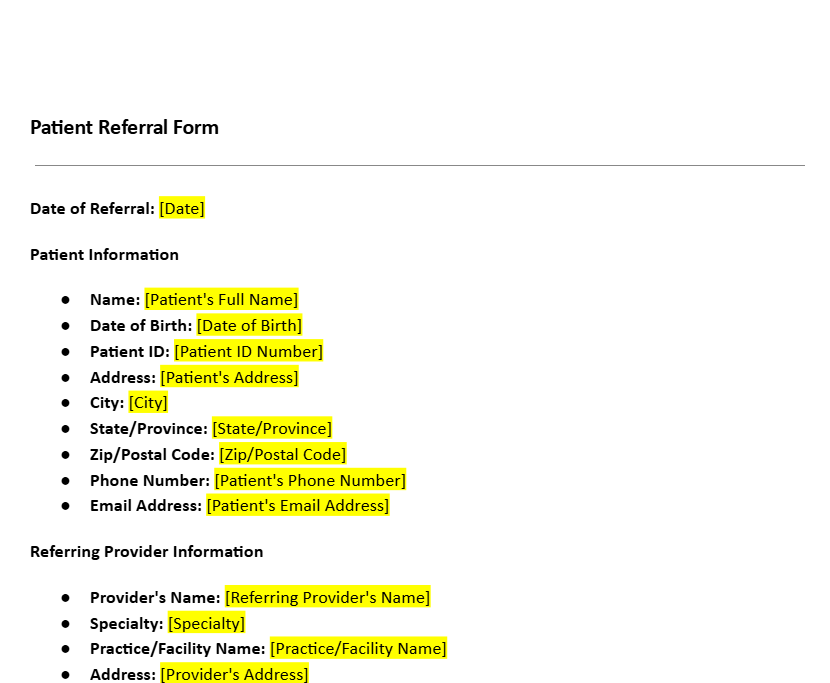
Accurate patient identification is fundamental. A standard patient referral form template records the patient’s full name, date of birth, demographic details, address and up-to-date contact information. This prevents mix-ups between patients with similar names and ensures results and correspondence are tied to the correct individual.
Template fields typically include existing diagnoses, chronic conditions and a concise history of treatment. This gives the receiving clinician meaningful context even before the first appointment. Some templates are structured as questionnaires, capturing lifestyle factors, functional status and social circumstances when relevant.
Referrals for psychiatric assessment, rehabilitation or long-term disease management may also record observations about mood, cognition, mobility, pain levels or daily functioning. Structured formats reduce the need for follow-up calls purely to fill information gaps.
Medical History and Patient Status
Accurate transfer of medical history prevents misdiagnosis, duplicate tests and conflicting treatment plans. A robust patient referral form template therefore includes space for previous surgeries, allergies, current and past medications, comorbidities and recent lab or imaging results.
Attaching or referencing key documents—such as discharge summaries, diagnostic reports or specialist opinions—gives the receiving clinician a well-rounded clinical picture. When such records are missing, specialists may have to repeat tests or postpone decisions, increasing cost and delaying care.
Healthcare Provider and Referral Information
A complete referral form must also identify the healthcare professionals involved. Typical sections capture the referring clinician’s name, credentials, department, facility and contact details, along with the name and speciality of the receiving provider.
A clearly designed patient referral form template differentiates whether the patient is being referred to, for example, a cardiologist, neurologist, orthopaedic surgeon, psychiatrist or physiotherapist. It allows the referring clinician to state the primary reason for referral, expected outcomes and specific clinical questions.
In complex cases where multiple specialists are involved, templates can include fields for provider coordination, previous consultations and agreed follow-up arrangements. This supports shared decision-making and reduces fragmentation of care.
The Types of Referral Forms in Healthcare
Medical and Health Referrals
Medical referral forms and physician referral forms are widely used to link patients with the next level of care. General medical referrals can cover anything from acute injuries to chronic disease management, directing patients towards specialist clinics, diagnostic centres or specific treatment programmes.
Physician referral forms are often more detailed, enabling specialists to review complex cases with the right background information. They help streamline transitions between providers, lower the risk of miscommunication and ensure investigations and treatment plans are aligned.
Additional documents—such as patient registration forms or programme applications—may accompany the core referral in long-term care, rehabilitation or disease-management pathways. Some organisations also use recurring report forms to track progress, response to treatment and follow-up recommendations.
Diagnostic referrals often use structured request forms for imaging, laboratory tests or specialised procedures. These forms sit alongside the main patient referral form template and clearly state which investigations are needed and why.
Mental Health and Social Services Referrals
In mental health, structured referral processes are crucial. A psychiatric or psychological referral typically includes diagnostic impressions, history of self-harm or suicidality, trauma history, medication lists and prior therapy notes. These referral forms must be handled under strict confidentiality in line with HIPAA and other privacy regulations.
Social services referrals use similar structure to connect individuals with housing support, disability services, substance-use treatment, domestic-violence shelters or community programmes. A patient referral form template adapted for social care records case history, risk factors and support needs, ensuring that handovers between medical teams and social workers are smooth and well-documented.
The Advantages of Referral Form Templates
Using a professionally designed patient referral form template offers clear practical benefits. Templates reduce clerical errors by providing pre-defined fields for contact details, clinical information, consent and provider data in a consistent layout.
Pre-formatted templates streamline documentation, allowing clinicians to focus on patient care rather than designing forms from scratch. Standardisation ensures that key information—like allergies, diagnoses and urgent concerns—is captured every time.
Editable digital templates support real-time updates, enabling quick corrections if medications change or new findings arise. Hospitals, clinics and specialty centres can tailor the base patient referral form template to match departmental protocols, clinical guidelines and local legal requirements while preserving structure.
Integrations and Workflow Automation
Modern healthcare technology enables referral tools to integrate with electronic health records (EHRs), practice-management systems and secure patient portals. When a patient referral form template is embedded in these systems, data can flow automatically between modules, reducing manual entry errors and lost paperwork.
Streamlined digital workflows are especially valuable for new patients and urgent cases, where delays can significantly impact outcomes. Online contact forms and referral requests linked to patient portals allow secure, direct communication between patients, referrers and specialists.
Some organisations even allow patients to initiate referrals or appointment requests online, with clinicians reviewing them within defined protocols. Automation reduces bottlenecks and helps maintain ongoing compliance with healthcare regulations and audit requirements.
Enhancing the Patient Experience
An organised, transparent referral process has a direct impact on patient experience. A clear patient referral form template helps shorten waiting times by ensuring specialists receive the right information from day one, enabling them to triage and schedule efficiently.
Transitions to new facilities often require multiple documents, such as transfer notes, discharge summaries and insurance authorisations. When these are aligned with a common referral template, the process becomes smoother for patients and families, who already may be under stress.
Healthcare providers increasingly use websites, brochures and social media to educate patients about how the referral system works and what information is required. This proactive communication, combined with a clean patient referral form template, reduces incomplete submissions and reinforces confidence in the system.
Automated reminders for appointments and follow-up consultations help ensure continuity of care, while feedback loops linked to the referral pathway support ongoing quality improvement.
The Importance of a Patient Referral Form Template
Ultimately, a standardised patient referral form template provides a reliable method to document transfers of care in a consistent, legally sound way. Pre-structured layouts improve accuracy by ensuring all essential sections—patient details, medical history, current concerns, provider information and consent—are addressed systematically.
Healthcare organisations that adopt electronic filing can use editable templates to keep information up to date and reduce duplication. Customisable form-builder tools allow departments to fine-tune the patient referral form template to match their workflows, specialties and reporting needs.
Printable versions keep the process accessible for settings that still depend on paper charts or hybrid systems. Standardised forms strengthen collaboration among clinicians, specialists, allied health professionals and administrative teams, reducing unnecessary delays and repeat clarifications.
In short, the organised design of a patient referral form template helps providers and patients move through care transitions with clarity, safety and minimum disruption.
Download a Patient Referral Form Template with a Free Trial of FreshDox
If you want to streamline your referral workflows and protect continuity of care, a professionally drafted patient referral form template from FreshDox can be a practical, time-saving solution. Our healthcare templates are structured to support accurate documentation, regulatory compliance and smoother communication between providers.
When you sign up for a free trial of a Basic or Premium account at FreshDox.com, you get limited-period access to a curated library of healthcare documents—including patient referral form templates, consent forms, intake forms and more. Each template is fully editable, so you can adapt it to your own clinical workflows and branding.
Download your chosen patient referral form template in PDF or Word format, customise it for your practice and integrate it into your digital or paper systems. Whether you run a private clinic, a multi-speciality centre, a hospital department or allied health service, these templates are designed to keep documentation clear and consistent.
Start your free trial today and explore the FreshDox library. With the right patient referral form template in place, your team can spend less time chasing paperwork and more time delivering the safe, coordinated, compassionate care your patients deserve.
Popular searches:
- Patient Referral Form Template: Essential Guide for Safer Care pdf
- Patient Referral Form Template: Essential Guide for Safer Care sample
- Patient Referral Form Template: Essential Guide for Safer Care download
- Patient Referral Form Template: Essential Guide for Safer Care format
- Patient Referral Form Template: Essential Guide for Safer Care template
- Patient Referral Form Template: Essential Guide for Safer Care word
- Patient Referral Form Template: Essential Guide for Safer Care free

 Download Word Template
 Download PDF Template
Related Templates
Discover more templates that align with your needs and preferences.













Ready to Sign Up?
Start your 7-day free trial and access professionally drafted legal documents built for business use.
- Cancel any time
- 7-day free trial
- From 300+ Customer Reviews
